(API access turned off Monday 28/9 00:00. Please continue to watch our video and repo :))
1. The problem Sell-side M&A advisors like Mergero win mandates one owner at a time, and finding the right owners early is their bottleneck. The best targets are founder-owned companies with €2–50M in revenue, whose owner is 55 or older or facing succession. Most of those owners have not yet decided to sell. Reaching them first is where the off-market value is: a private conversation before any auction, with options from growth capital or a minority stake to a full sale. Today every prospect starts as a thin database row that an analyst researches by hand. Templated mass email has already failed, because each message has to show why this company and this owner.
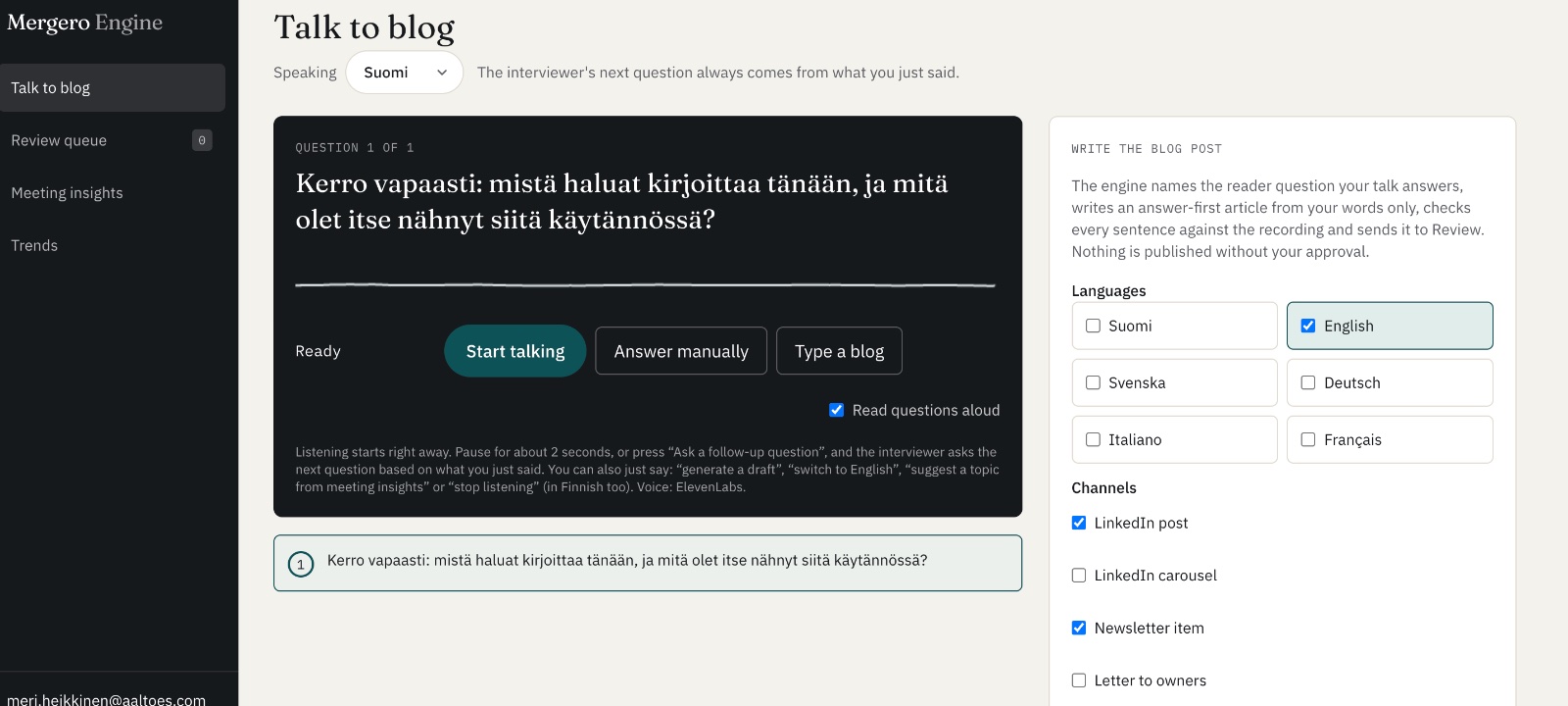
2. What we built The Mergero Origination Desk, a web app that takes an advisor from the public company register to a first owner conversation. It pulls owner-led companies from the open registers of Norway, Finland and Denmark. Norway alone has 35,113 limited companies with 10–250 staff in Mergero's size range, and its roles register gives each CEO's real age. Every company is researched, ranked by how likely the owner is to need an advisor now, and matched against buyer mandates. The desk drafts the first email and follow-ups, which the advisor approves and sends under their own name, within a daily cap. Replies come back read and re-scored, interested owners get a private intake link, and the pipeline tracks each owner to the engagement letter. It also runs as an MCP server, so it plugs into the Claude → MCP → database workflow Mergero already uses. In the demo, companies, owner ages and filed accounts are real. Buyer mandates are anonymised samples until Mergero's MGX buyer data is connected, and every email is redirected to our own inbox.
3. How it works, and what's AI about it AI agents do the analyst's research and first draft, and the advisor approves every message. The desk crawls each company's website and pulls its filed accounts, reading scanned statements with OCR. A model extracts the facts and keeps one only if its quote appears on the page it cites. Rule-based signals such as owner age, tenure and filed figures rank each company, and the model writes a plain "why now" backed by evidence. A writer agent drafts the email from the company's own facts, leading with buyer demand and never saying "sell" in a first touch. A rule-based linter blocks templated or AI-sounding text and requires two sourced facts; a humanizer agent rewrites whatever fails. When an owner replies, in any language, an agent drafts the answer and re-scores readiness, quoting the owner's own words. The intake link is a short conversation with an agent that turns the owner's answers into a structured summary. Every model call runs on Mistral Small 3, an open-weight model we self-host on a Verda GPU server in Finland, so no company or owner data goes to an outside AI provider. The provider is a setting, so the same agents also run on Claude.
4. We'd love to see what's next: A six-week pilot with Mergero: Norway, one sector with strong buyer appetite, and two advisors sending up to 75 personal emails a day each. Success is measured in first calls booked, compared with Mergero's current outbound. If the desk wins, we hand it over. For the pilot we connect live buyer mandates from MGX, whose sync is already built, and add an opt-out to every email. Real reply, meeting and mandate rates then replace the sample data in the learning loop, so scoring and framing learn from actual outcomes. After the pilot: Sweden, Mergero's preferred market, through a data provider, and DACH through LinkedIn and calls, which the desk already routes by country.