## The problem
Velho sells a monthly partnership: a named expert finds the manual work slowing a team down, builds the fix, and gets people using it. The promise is strong and the bottleneck is upstream of it — Velho needs to be seen by the right companies and in the room with them.
Most outbound tooling optimises the wrong end of that sentence. It sends more, to more people, faster. Volume is not the problem. The problems are:
1. "The right companies" is a judgement, not a list. A 6-person garage with manual work is not a fit. A 300-person public procurement office with manual work is not a fit either. The difference has to be argued, not assumed. 2. Manual work is invisible from outside. You cannot buy a database of "who reconciles paperwork by hand on Fridays". Somebody has to name the specific process and the specific person who owns it. 3. "In the room" is evidence, not intent. An opened email is not a room. A meeting with a calendar hold and a named attendee is a room.
## What we built
A three-stage agent that stops at each verb in Velho's own sentence and produces evidence for it.
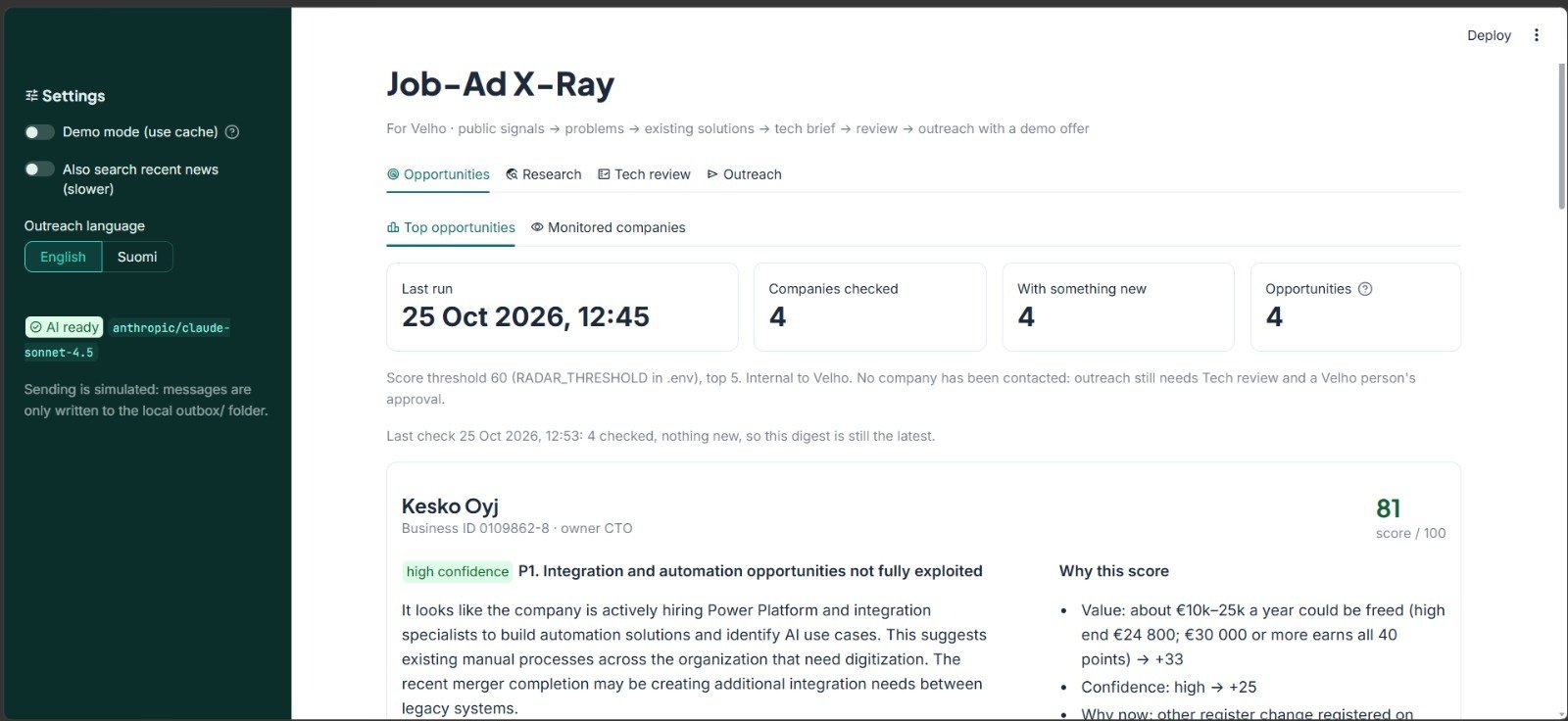
Seen. Every company is scored against a locked ICP with the reasoning printed. Not a score in a database — a sentence you can argue with: `headcount 180 inside 50-500; has manual_work_signal; has named_owner_of_process`.
The right companies. Fit is a filter with a floor, not a ranking with a top. Companies below the floor are rejected with reasons, and the reasons are printed alongside the shortlist. From the actual verified run:
- `C-04 Helsinki Procurement Office scored 6 -- anti-fit: public sector procurement`
- `C-03 Tiny Garage Ky scored -2 -- headcount 6 outside 50-500; missing named_owner_of_process`
- `C-06 Dormant Holdings Oy scored -3 -- missing manual_work_signal; missing named_owner_of_process`
A system that only ever produces a shortlist is not choosing. The rejection list is the proof that a choice was made.
In the room. For each qualified company the agent names the process owner, drafts the first touch against the specific manual work found, and books a slot with a calendar hold, a named attendee, an agenda, and an invite address. From the run:
- `2026-10-26 14:00 Nordic Fleet Group / Simo Anttila (Logistics Manager)`
- `2026-10-26 16:00 Kampi Import Oy / Andreas Jansson (Import Manager)`
- `2026-10-26 18:00 Baltic Wheels AS / Esa Wicklund (Logistics Manager)`
- `agenda: map one manual process, agree on a one-month fix scope`
Each first touch quotes the manual work back to the person who owns it: "We noticed Nordic Fleet Group runs vehicle transfer orders keyed in by hand from dealer emails into three separate spreadsheets." That sentence is the whole product. It is why this is not spray.
## How it works, and what is AI about it
The AI is in the scoring and the match, not in the prose. Three things the agent decides that a filter cannot:
- Which signals matter. Must-haves carry weight 3, nice-to-haves weight 1, headcount in band weight 2, and anti-fits subtract 5. The weights are visible and editable, which means a Velho expert can tune the ICP and see the effect immediately.
- Which manual work to lead with. The draft is built from the specific process found at that company, not from a template with the name swapped.
- Who to talk to. Process owner for the first touch, budget holder recorded separately. Talking to the buyer first is how these deals stall.
The agent is deliberately honest about a limit it has: every company in this run is seeded data. Scoring a real company requires the manual-work signal to be observed, and the system marks a company with no observed signal as rejected, not as "unknown but promising".
## What is next
- Signal collection as a real stage: job posts, process-owner titles, public statements about admin load.
- Checking a real calendar for free/busy before booking, rather than assuming a per-company offset is enough.
- Reply handling: what the agent does when someone says yes, no, or nothing.
- Handoff to the named Velho expert with the manual-work dossier attached, so month one starts with the work already found.